How AI Is Transforming Healthcare Operations and Patient Access in 2026
Healthcare organizations are facing a difficult reality in 2026. Patient expectations continue to rise while staffing shortages, increasing administrative workloads, and operational inefficiencies place unprecedented pressure on clinics and health systems. For many healthcare providers, the challenge is no longer delivering quality care inside the exam room, it's ensuring patients can access that care in the first place.
Artificial intelligence (AI) is emerging as one of the most significant technologies helping healthcare organizations bridge this gap. While media headlines often focus on AI-powered diagnostics and clinical decision support, some of the most impactful applications of AI are happening behind the scenes, improving patient access, streamlining administrative workflows, and reducing operational bottlenecks.
Today, healthcare leaders are increasingly investing in AI-driven patient solutions, intelligent call routing, automated scheduling, and workflow automation to improve efficiency while maintaining high standards of patient care.
The Growing Patient Access Challenge
Patient access has become one of the biggest operational challenges in healthcare.
Many medical practices receive hundreds of inbound calls every day from patients seeking appointments, prescription refills, billing support, referral information, and general assistance. As call volumes increase, front-desk teams often struggle to keep up.
Industry benchmarks indicate that mid-sized healthcare practices can experience call abandonment rates between 12% and 18%, while average hold times often range from three to six minutes. Poor patient access experiences can directly impact patient retention, satisfaction, and revenue. Studies suggest that many patients will consider switching providers after repeated communication frustrations.
The consequences extend beyond inconvenience. Missed calls frequently translate into missed appointments, delayed treatment, and lost opportunities to engage patients in their care journey.
Healthcare organizations are increasingly recognizing that patient access is no longer simply a scheduling issue. It is a strategic component of patient experience and organizational growth.
Why AI Is Becoming Essential for Healthcare Operations
Artificial intelligence offers healthcare providers an opportunity to automate repetitive administrative tasks while allowing clinical and administrative staff to focus on higher-value activities.
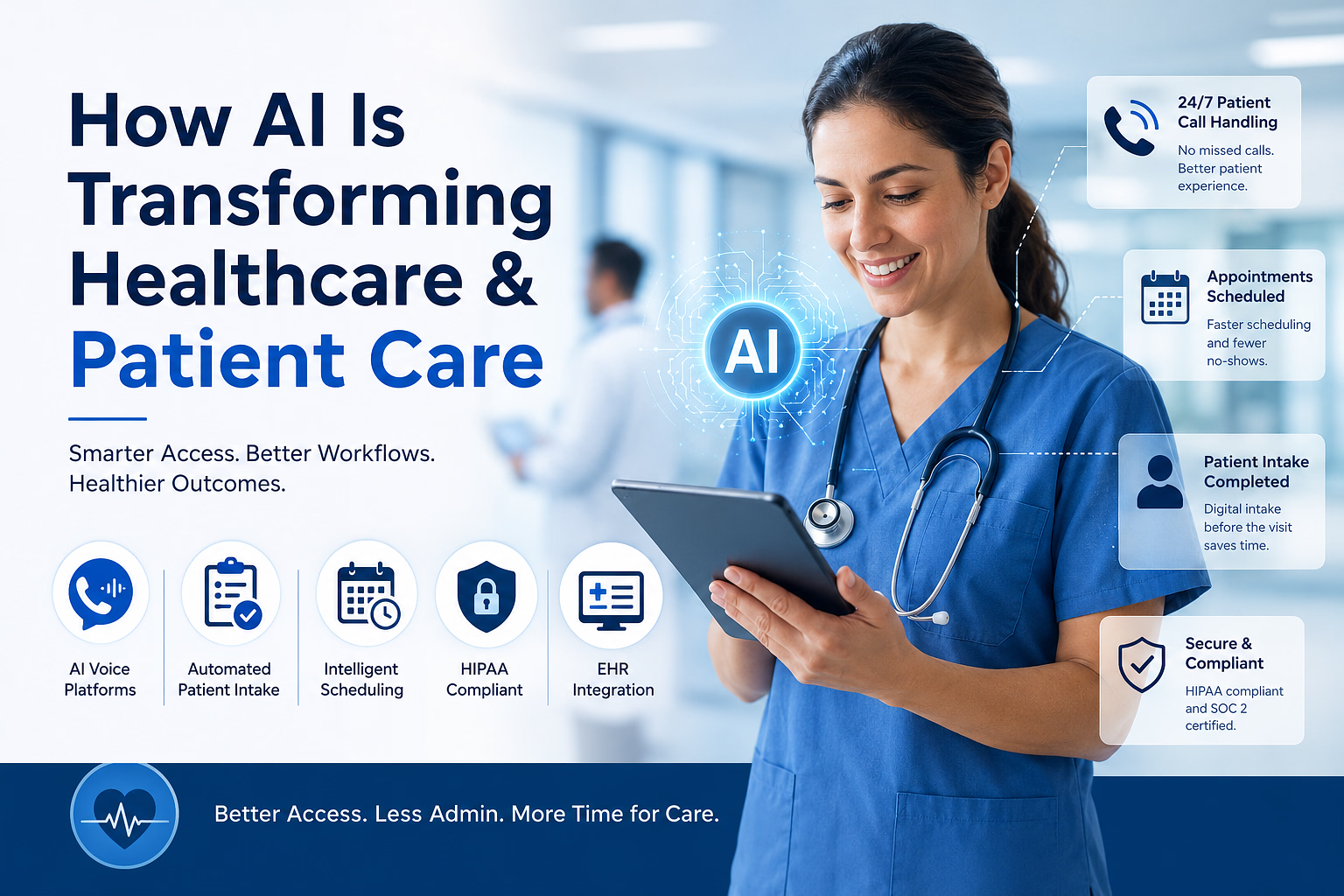
Modern healthcare AI platforms can:
- Answer patient calls instantly
- Route inquiries to the appropriate department
- Schedule, reschedule, and confirm appointments
- Process prescription refill requests
- Handle billing inquiries
- Automate patient outreach campaigns
- Support patient intake workflows
- Integrate directly with electronic health records (EHRs)
The goal is not to replace healthcare professionals. Instead, AI helps eliminate repetitive administrative work that often contributes to staff burnout and operational inefficiencies.
As healthcare organizations continue to face workforce shortages, automation is becoming a practical necessity rather than a future aspiration.
AI Voice Technology Is Reshaping Patient Communication
One of the fastest-growing segments within healthcare AI is voice automation.
Traditional phone systems rely on complex menu structures that force patients to navigate multiple prompts before reaching the appropriate department. Modern AI voice systems use natural language understanding to conduct human-like conversations with callers.
Patients can simply explain why they are calling, and the AI can determine intent, answer routine questions, complete transactions, or transfer the call with full context when human intervention is needed.
This capability significantly improves the patient experience by reducing wait times and eliminating unnecessary transfers.
Healthcare providers also benefit from improved operational efficiency. AI-powered systems can manage multiple conversations simultaneously while maintaining consistent service levels, even during peak call periods.
The Importance of EHR Integration
While conversational AI has advanced rapidly, successful healthcare automation depends heavily on integration.
One of the most common challenges discussed by healthcare technology professionals is the difficulty of connecting AI systems with legacy EHR platforms. Many organizations discover that answering calls is relatively easy; integrating scheduling, patient records, and workflows is where real complexity begins.
Without EHR integration, staff often need to manually transfer information between systems, creating inefficiencies and increasing the likelihood of errors.
Healthcare organizations should prioritize AI solutions that support real-time integration with major EHR platforms such as Epic, Cerner, athenahealth, eClinicalWorks, NextGen, and Allscripts.
The most successful deployments allow AI to operate directly within existing workflows rather than requiring providers to adopt entirely new processes. This approach reduces implementation friction and accelerates adoption across the organization.
Real-World Example: Improving Patient Access Through AI
A practical example of this transformation can be seen through healthcare-focused AI platforms such as CuroAI.
Built by operators with decades of experience managing patient access environments, CuroAI focuses specifically on solving operational challenges that healthcare organizations face every day. According to the company, its platform captures patient calls, automates routine scheduling, and integrates directly into existing EHR workflows without requiring major workflow redesigns. The platform reports call capture rates approaching 98%–100%, automation of 40%–60% of routine calls, and structured escalation processes that maintain clinical oversight when needed.
One notable aspect of the platform is its healthcare-specific design. Rather than adapting generic customer service automation, the solution was developed by teams with extensive experience operating healthcare call centers and patient access programs across multiple health networks. This operational background helps address one of the biggest challenges in healthcare AI: aligning technology with real-world clinical workflows.
For growing clinics struggling with high call volumes, missed calls, and staffing pressures, solutions like these demonstrate how AI can improve both operational efficiency and patient experience simultaneously.
Why Governance and Trust Matter
As healthcare organizations adopt AI technologies, governance has become just as important as functionality.
Healthcare differs from most industries because patient safety, privacy, and compliance requirements are non-negotiable.
The strongest healthcare AI platforms are defined not only by what they can do but also by what they are designed not to do.
Industry experts increasingly emphasize the importance of clear escalation pathways, human oversight, auditability, and strict limitations on AI-generated clinical guidance. In healthcare environments, AI should support workflows—not replace medical judgment.
Organizations evaluating AI solutions should examine:
- HIPAA compliance
- SOC 2 Type II certification
- Data encryption standards
- Business Associate Agreements (BAAs)
- Audit trail capabilities
- Escalation procedures
- Human-in-the-loop controls
These governance measures help build trust among both patients and healthcare professionals.
Key Questions Healthcare Leaders Should Ask
Before implementing an AI solution, healthcare leaders should evaluate several critical factors.
Does the platform integrate with existing systems?
Integration with EHRs, communication platforms, and scheduling systems is essential for long-term success.
How is patient data protected?
Security controls should include encryption, compliance certifications, and comprehensive audit capabilities.
What workflows can be automated?
Organizations should identify repetitive processes that consume significant staff time, such as scheduling, intake, routing, reminders, and follow-up communications.
How are clinical escalations handled?
AI systems should have clearly defined escalation rules and immediate access to human support when patient safety concerns arise.
What ROI can be expected?
Healthcare leaders should evaluate metrics such as call capture, appointment conversion, reduced abandonment rates, staffing efficiency, and patient satisfaction improvements.
The Future of AI in Healthcare Operations
Healthcare organizations are moving beyond experimentation and into large-scale operational deployment of AI technologies.
Over the next several years, AI will likely become a foundational component of patient access infrastructure, helping organizations manage growing demand while improving service quality.
The greatest value will not come from replacing healthcare professionals. Instead, it will come from enabling them to focus on what they do best: caring for patients.
As AI continues to mature, healthcare organizations that prioritize patient access, workflow integration, governance, and operational efficiency will be best positioned to deliver exceptional patient experiences while maintaining sustainable growth.
In 2026, the question is no longer whether AI belongs in healthcare operations. The question is how quickly healthcare organizations can implement it responsibly and effectively.
FAQs
- How can AI improve patient access in healthcare?
- AI improves patient access by answering calls instantly, automating appointment scheduling, reducing hold times, and routing patients to the right department without delays. This helps healthcare providers serve more patients efficiently.
- What are the biggest benefits of AI for healthcare operations?
- AI helps healthcare organizations reduce administrative workload, automate repetitive tasks, improve scheduling efficiency, lower call abandonment rates, and enhance the overall patient experience.
- Can AI integrate with existing healthcare systems?
- Yes. Modern healthcare AI solutions can integrate with major EHR platforms such as Epic, Cerner, athenahealth, and eClinicalWorks, allowing organizations to automate workflows without disrupting existing processes.
- Is AI safe and compliant for healthcare use?
- Healthcare AI platforms should meet strict compliance requirements, including HIPAA standards, data encryption, audit trails, and secure patient data handling. Organizations should evaluate governance and security before implementation.
- Will AI replace healthcare staff and call center teams?
- No. AI is designed to support healthcare teams by handling routine administrative tasks, allowing staff to focus on patient care, complex inquiries, and higher-value interactions that require human expertise.