Building AI for Healthcare: What Developers Get Wrong About Appointment Scheduling
Most teams building healthcare AI start by asking the wrong questions. They focus on how accurate speech recognition is or how natural an AI voice sounds during a call. These technologies are already well developed. Speech-to-text, text-to-speech, and AI conversation tools are now widely available, and most teams with the right resources can connect them fairly quickly.
The more important question is different: Can the system safely perform real actions inside a healthcare workflow while following compliance requirements and working in real time? This is what determines whether a healthcare AI product can actually work in a real clinical environment.
Appointment scheduling is a useful example because it brings together many of the difficult parts of healthcare AI. The system needs live information, access to the correct source of data, very fast response times, and a high level of accuracy. This guide explains what is needed to build such a system, from the AI architecture to the EHR integration and actual appointment write process.
Start With the Job, Not the Voice
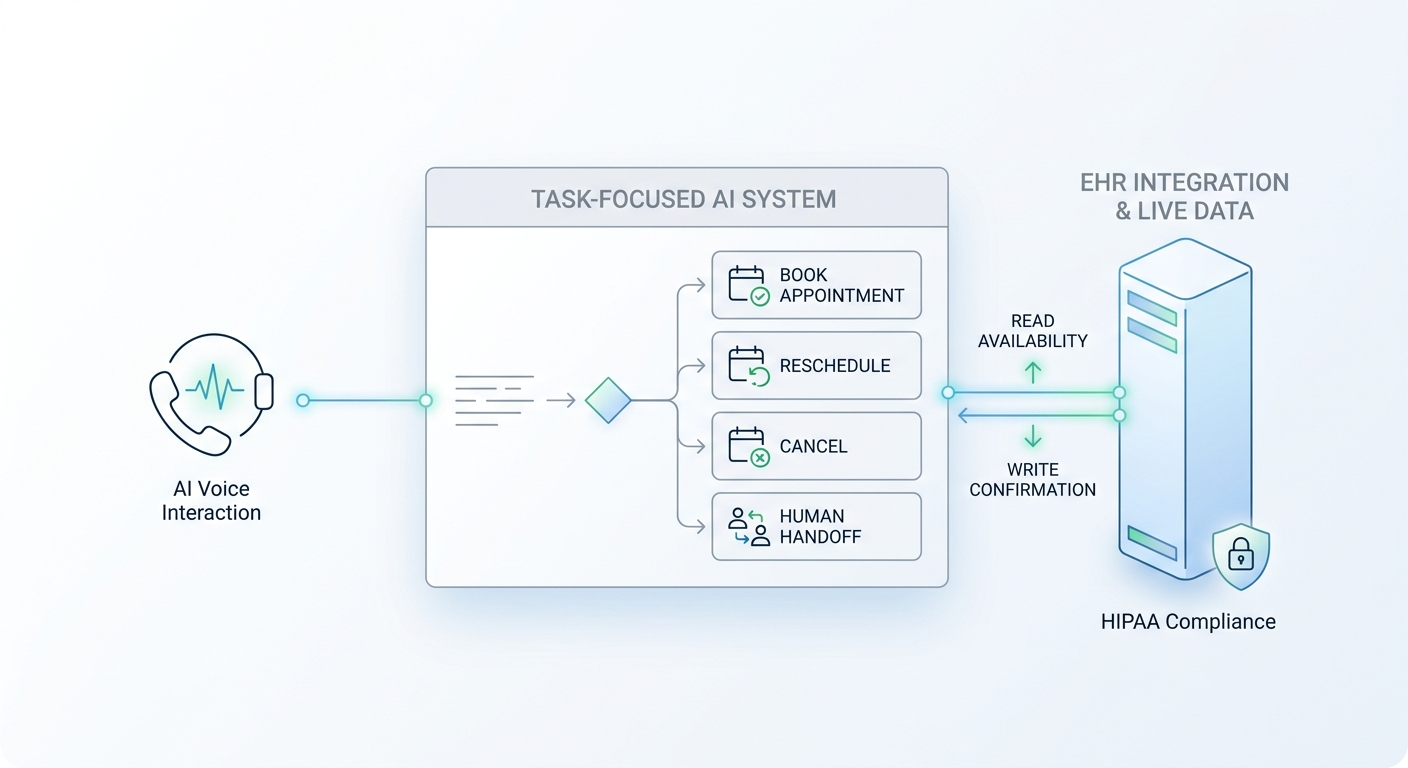
The main job of a scheduling agent is to finish a call with the correct action completed. This could mean booking an appointment, changing an existing appointment, cancelling an appointment, or transferring the patient to a human. Everything the AI says or does during the call should support this final goal.
This changes the way the system should be designed. Instead of thinking about it as a chatbot that can talk, developers should think about it as a task-focused system that uses voice as the way to communicate. The goal is not simply to have a natural conversation. The goal is to complete the patient's request correctly.
What the Agent Needs to Do
The agent needs a clear plan for each part of the conversation, such as checking availability, confirming the patient, suggesting a time, or booking the appointment.
It must also remember what has been confirmed, what information is missing, and what has already been saved to the EHR.
Every action must be confirmed before it is considered complete. An appointment is only booked when the EHR confirms it.
Platforms such as Curo AI use separate workflows for tasks like scheduling, refill requests, and billing instead of using one general voicebot.
Designing the Core AI Development Layers
1. Intent and Slot Handling
Scheduling conversations usually follow a clear structure, even when patients provide information in different ways. The system needs to understand the patient's request and collect the required details.
It should identify the action, such as booking, rescheduling, or cancelling, along with the provider, preferred date and time, and patient identity. It should also understand unclear requests like "next week" or "after work."
The system must handle changes during the call without making the patient repeat everything. For example, if the patient changes Wednesday to Thursday, the system should update the request smoothly.
2. Grounding the Model in Live Data
This is one of the biggest differences between healthcare AI and a normal conversational AI system. The model should never suggest an appointment time based on old information or a stored schedule. It needs to check the provider's current availability before giving the patient a time.
If scheduling information is treated as static data, the system may offer appointments that are no longer available. This can lead to incorrect information, failed bookings, and a poor patient experience. The scheduling system therefore needs to work directly with current information.
The EHR Is the Source of Truth
The EHR should always be the main source of truth. Availability checks must use live data, and every appointment booking should be confirmed before the call ends.
If another patient takes the selected time, the EHR should take priority. The AI should explain the issue and offer another available time instead of saying the appointment was booked.
Compliance as an Architecture Decision
For developers coming from consumer AI, this is one of the biggest changes in thinking. In healthcare, HIPAA compliance should not be added after the product has already been built. Compliance needs to be considered from the beginning because it affects how the entire system is designed.
Data, Security, and Access
Developers need to know where patient transcripts are stored and who can access them. Any third-party AI service handling patient data should be included in security reviews.
Patient data must also be properly protected. It should be encrypted during transfer and storage, using standards such as TLS 1.3 and AES-256.
The system should keep clear audit records of API calls, transcripts, and data queries. These records can help healthcare organizations review activity and investigate problems.
A signed Business Associate Agreement should be completed before patient data is processed. Companies such as Curo AI also provide detailed information about integrations with EHR systems like Epic, Cerner, and athenahealth.
Engineering for the Latency Budget
A chatbot can take a few seconds to respond without causing much trouble. A phone call is different. Even a few seconds of silence can make a patient think the call has stopped working. Voice AI therefore needs to respond much faster than a normal chatbot.
Production voice AI in healthcare typically needs a response time of roughly one second or less between the patient finishing their speech and the system beginning its response. This requirement affects the way the entire system needs to be designed.
Stream the Entire Process
Speech recognition, AI reasoning, and text-to-speech should work as a continuous streaming process. Technologies such as WebSockets can help keep these steps running together instead of making the system wait for each separate request to finish.
Hide Slow Operations
Some operations can take longer than the response-time target. For example, checking appointment availability across several facilities may require more time than the patient should have to wait in silence.
The system can use a short conversational message while the search happens in the background. It could say, "Let me check Dr. Smith's calendar for next Tuesday," while the system searches for the actual availability.
Start Work Early
The system can also begin retrieving information as soon as it understands the patient's intention. For example, if the patient starts saying that they want to reschedule an appointment, the system can begin looking up their existing appointment before the patient finishes speaking.
Telephony services such as Twilio or RingCentral handle the phone connection itself. However, keeping the AI response fast is mainly an application and AI development problem rather than simply a telephony configuration issue.
Building Escalation Into the System
A healthcare AI system must know which tasks it can handle and when a human should take over. Simple tasks like scheduling, refill requests, and basic billing questions can usually be automated. Urgent, unclear, or sensitive situations should be transferred to a human.
The handoff should be treated as an important safety feature. It needs proper testing and monitoring to make sure the system sends the right situations to human staff.
What a Good Handoff Includes
A good handoff should transfer the call along with the information already collected. Staff should receive the patient's identity, request, and actions completed by the AI before answering the call.
Most importantly, the patient should not have to repeat their story. A poor handoff is not just a user experience problem. It can also create a patient safety risk and should be tested carefully.
Where EHR Integration Fits In
Everything discussed above helps make a scheduling agent work well. EHR integration is what allows the agent to actually complete the task. Without a working connection to the healthcare organization's EHR, the AI may be able to talk about appointments but will not be able to book them.
Why EHR Integration Is Difficult
EHR integration is complicated because different healthcare systems use different APIs, rules, limits, and ways of representing appointment information. Examples include Epic, Cerner, athenahealth, eClinicalWorks, and NextGen.
Many modern integrations use HL7 FHIR REST APIs to read schedules and write appointment information. Older systems may require proprietary APIs or middleware. Because of these differences, EHR integration is not one simple feature. Each system may require its own engineering work.
Handling EHR Problems
If an EHR API stops working during a live call, the system needs a clear backup process. It should collect the patient's request, explain that someone will follow up, and send the request to the appropriate staff member.
The system should never fail silently or simply drop the call. The patient's request needs to be saved and passed to the staff so that the issue can be handled later.
What This Means for Developers
If you are building a healthcare scheduling system yourself, a practical order is to start with the task-focused architecture. After that, design the data flow around healthcare compliance and build the EHR write path.
Once those parts are working, focus on improving response times. Finally, add the escalation system and test it carefully. Human escalation may be added later in the development process, but it should receive some of the most careful testing because of its importance to patient safety.
If you are evaluating a healthcare AI vendor, do not focus only on voice quality. Ask how the system handles appointment conflicts, whether a signed BAA is available, how fast the system responds during real calls, and what situations cause a human handoff.
You should also ask which EHR systems are supported, how integrations are maintained, how the handoff process is tested, and what happens if an EHR system becomes unavailable. Platforms such as Curo AI provide detailed information about their EHR integrations and compliance approach, which can make the technical work easier to evaluate.
Key Takeaways
AI development is about completing real tasks, not just creating natural conversations. In healthcare appointment scheduling, the AI needs to understand the patient's request, interact with the right systems, and complete the task accurately.
AI systems need reliable, real-time data. The EHR should remain the source of truth for appointment availability and completed actions, ensuring the AI does not provide outdated information or confirm actions that were not successfully completed.
Security and compliance should be built into AI development from the beginning. Healthcare AI requires careful handling of patient data, controlled system access, secure integrations, and clear audit records throughout the development process.
Production-ready AI requires more than a powerful model. Fast response times depend on the entire system architecture, including streaming, early data retrieval, parallel processing, reliable integrations, and efficient communication between the AI and EHR.
Human oversight is an important part of reliable AI development. Healthcare AI should have clear boundaries and escalation workflows so complex, sensitive, or uncertain situations can be safely transferred to human staff.
Ready to Build a Reliable Healthcare AI Solution?
From AI appointment scheduling to intelligent workflow automation, Software Developers Pro can help you develop secure, production-ready AI solutions that integrate with your existing systems.
FAQs
What APIs are typically used to integrate healthcare AI with EHRs?
Most modern integrations use HL7 FHIR REST APIs to read provider schedules and create or update appointments. Older healthcare systems may require proprietary APIs, direct database connections, or integration middleware.
How do healthcare AI systems maintain fast response times during EHR checks?
They can stream audio through WebSockets, run multiple searches at the same time, retrieve information early based on the patient's intent, and use short conversational messages while slower operations are running in the background.
Is healthcare AI required to be HIPAA compliant?
Yes. Systems that process, transmit, or store Protected Health Information, including patient names, call recordings, and appointment details, need to follow HIPAA requirements. They also generally need a signed Business Associate Agreement with the healthcare organization.
What happens if an EHR API goes down during a live call?
The system should handle the situation safely instead of failing or dropping the call. It should collect the patient's request, explain that a staff member will follow up, and send the request to the appropriate healthcare staff for later action.